Bladder Health
Pads vs. Leakproof Underwear: What Really Holds a Leak (and What Just Feels Like It Does)
Most women start with whatever is in the bathroom cabinet. Then come the bladder pads, the spare pair in the purse and the dark pants “just in case.” Here’s what each option is really built for, and how to tell which one fits your kind of leak.
 By Rebecca M. · Updated: October 2026 · Reading time: 5 minutes

You’re not unusual if you’ve tried three different things already. In a University of Michigan poll of women aged 50 to 80, 59% of women with bladder leaks used special pads or underwear to manage them. The trouble is that “for leaks” on a package can mean very different things.
Period pads: made for something else
Period pads are designed for menstrual flow, which arrives slowly and steadily over hours. A bladder leak is different: thin liquid, all at once, often while you’re moving. A pad built for a slow trickle can’t always pull a sudden gush in fast enough, so some of it runs to the edges.
They’re fine for the occasional drop. For anything more, they’re simply the wrong tool, even though they’re the first thing most of us reach for.
Bladder pads: better, but still a strip
Bladder pads are made for urine, so they absorb faster and hold more than period pads. That’s a real step up.
But they’re still a separate strip stuck inside your underwear. They can bunch up, twist or slide when you walk, sit or bend, and some crinkle. You need to change them during the day, carry spares, and keep buying them.

Disposable briefs: they hold, but you feel them
Disposable incontinence briefs hold the most of any option here. For heavy leaks, urge leaks or overnight, they’re often the right choice, and there’s nothing to be embarrassed about in using them.
For everyday light-to-moderate leaks, though, many women find them more than they need: bulkier under leggings, sometimes noisy, and an ongoing cost because you throw each one away.
Leakproof underwear: the protection is the underwear
Leakproof underwear moves the protection into the fabric itself. There’s no strip to stick in, so there’s nothing to bunch or shift. Good ones are built in layers, each with one job, and they look and feel like ordinary underwear. You wash them and wear them again.
Inside a 4-layer leakproof brief
A cross-section of the protected area, skin side at the top
Illustration based on DryGuard’s 4-layer design. Other brands use different layers.
The catch: it holds less than a disposable brief, and how much it holds varies a lot between products. That’s why the absorbency number matters (more on that in the checklist below).
All four side by side
| Option | Made for | Stays in place? | Reusable? | Best for |
|---|---|---|---|---|
| Period pads | Slow menstrual flow | Can shift | No | The occasional drop |
| Bladder pads | Urine | Can bunch or slide | No | Light leaks, short-term |
| Disposable briefs | Urine, large amounts | Yes | No | Heavy leaks, urge leaks, nights |
| Leakproof underwear | Urine (check the label) | Yes, it’s your underwear | Yes, washable | Light to moderate everyday leaks |
What to check before you buy
Whatever brand you look at, these five questions tell you more than the photos do.
- Is it made for bladder leaks, or for periods? Underwear sold mainly as period underwear is built for slow flow. Look for products that say they’re made for urine.
- Does it say how much it holds? Look for a number in ml or oz. “Up to 100% protection” isn’t a measurement. If the brand doesn’t give one, ask.
- Where does the protection sit? Bladder leaks come out further forward than a period. The absorbent area should start at the front.
- Do the leg openings sit close? Loose leg openings are where a sudden leak escapes. Check the fit and the size chart.
- Can you return it? Underwear often can’t be returned once worn. Check the policy before you order, and order your usual size first.
Where DryGuard fits
DryGuard Leakproof Underwear is made for bladder leaks rather than periods, and it says what it holds: up to 60 ml (about 2 oz), which suits the light-to-moderate leaks from a cough, a laugh or a sneeze. It’s built with the 4 layers shown above in a soft cotton brief you machine wash and wear again, in sizes XS to 4XL. If you leak more than that at once, a disposable brief is the better choice.

From DryGuard
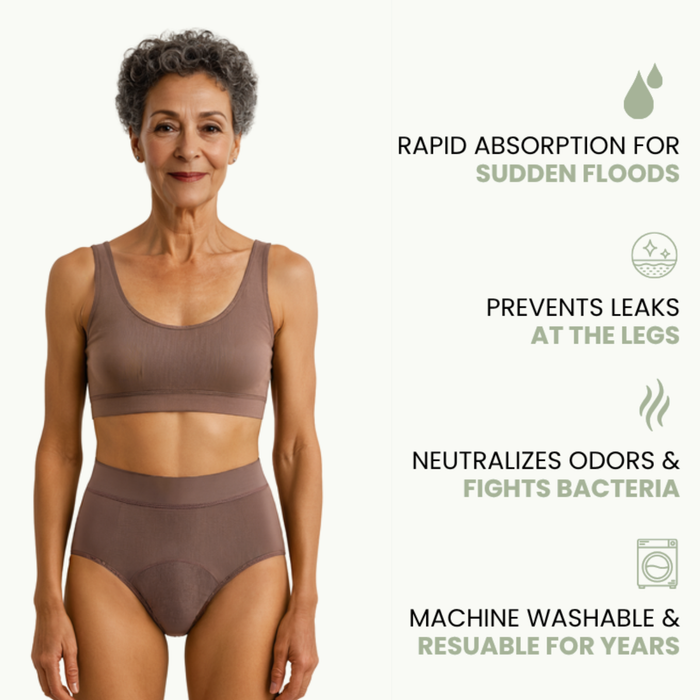
DryGuard Leakproof Underwear. 4 layers of leak protection built into a soft cotton brief: a top layer pulls moisture away from your skin and the core holds up to 60 ml (about 2 oz). Sizes XS to 4XL, in black, beige, dark brown and light brown. Machine washable.
4.8 stars · 1,356 reviews on the DryGuard shop
$69 for 3 pairs (about $23 a pair) · free shipping · 6- and 9-pair packs also available
Over 50,000 women have chosen DryGuard.
Common questions
Can I use period underwear for bladder leaks?
For a few drops, often yes. For sudden leaks it may struggle, because it’s built for slow flow and its protection usually sits further back. Underwear made for bladder leaks is the safer choice.
How much does leakproof underwear hold?
It varies widely between products, from a few teaspoons to several pads’ worth. Check the number in ml or oz on the product page. DryGuard holds up to 60 ml (about 2 oz).
Is leakproof underwear cheaper than pads?
It costs more at the start but you reuse it, while pads and disposable briefs are bought again and again. How quickly it pays off depends on how many pads you use now.
Can I wear it at night?
If your leaks at night are light, often yes. If you leak a lot overnight, a disposable brief or an extra pad may be the safer choice. Try a night at home first.
Should I see a doctor about leaks?
Yes, especially if leaks are new, getting worse, painful, or come with blood in your urine. Pelvic floor exercises and other treatments help many women. Good underwear manages leaks; it doesn’t treat the cause.
This article is general information, not medical advice.
More from the blog
Sources
- University of Michigan IHPI: Half of women over 50 experience incontinence, but most haven’t talked to a doctor (National Poll on Healthy Aging, with AARP)
- MedlinePlus (US National Library of Medicine): Stress urinary incontinence
- Mayo Clinic Q and A: Behavioral treatment can help control incontinence