Bladder Health
A Little Leak When You Laugh, Sneeze or Jump? Why It Happens After 50, and What Helps
It starts with a few drops when you sneeze. Then one day a laugh catches you out, or picking up your grandchild. You start choosing dark pants and noticing where the restrooms are. You’re far from alone, and it isn’t something you did wrong.
 By Rebecca M. · Updated: October 2026 · Reading time: 5 minutes

Why it starts after 50
The bladder sits on a hammock of muscle called the pelvic floor. Those muscles, and the tissue around the tube that carries urine out, are what keep it closed when something presses down.
Two things wear that support down over the years. Pregnancy and childbirth stretch the pelvic floor, and menopause brings hormone changes that affect the bladder, the urethra and the pelvic floor muscles. That’s why leaks so often appear, or get worse, from your late forties on.
Why bladder leaks start after 50
Less estrogen, weaker tissue, more leaks
- Women with bladder leaks
- Estrogen level (relative, typical pattern)
Sources: University of Michigan National Poll on Healthy Aging, sponsored by AARP and Michigan Medicine (2018), women 50–80. Estrogen pattern: Study of Women’s Health Across the Nation (Randolph et al., JCEM 2011). Average age of last period: Stanford Medicine.
When that support weakens, the pressure of a sneeze, a laugh or a jump can push a little urine out before you have time to tense up. It’s out before you can cross your legs. Doctors call this stress incontinence. “Stress” means physical pressure, not worry, and it has nothing to do with being careless.
And it keeps climbing with age: US health survey data show moderate to severe leaks aremore than four times as common after 80 as before 40.
When leaks happen
Women with bladder leaks who said it happens when…
- Coughing or sneezing79%
- Not reaching the bathroom in time64%
- Laughing49%
- Exercise37%
Source: University of Michigan National Poll on Healthy Aging (2018). Women could give more than one answer.
Many women have more than one kind. Alongside the sneeze-and-laugh leaks, there’s the sudden urge that doesn’t give you enough time to reach the bathroom. Those leaks tend to be bigger, and they’re harder to predict.
Do Kegels help?
Yes. Pelvic floor exercises are one of the most effective treatments for many women, and they’re worth doing. But they take weeks to months to make a difference, and many women aren’t sure they’re doing them right. A pelvic floor physiotherapist can check your technique in one or two visits.
In the meantime, the leaks don’t wait. You still need protection that works today, without planning your day around it.
What most women try first, and where it falls short

- Panty liners and period pads are made for a slow, steady flow. A sudden gush can run past them before they soak it up.
- Bladder pads hold more, but they’re a strip stuck inside your underwear. They can bunch up and shift when you move.
- Disposable briefs hold the most, but they’re bulky under clothes, and you keep buying them.
In the Michigan poll, 59% of women with leaks used special pads or underwear to manage them. Most never mentioned the leaks to a doctor.
Protection that’s already in your underwear
Leakproof underwear looks and feels like ordinary underwear, but the protection is sewn in. A top layer pulls moisture away from your skin, an absorbent core holds it, and an outer layer keeps it off your clothes. Nothing to stick in, nothing to shift.
DryGuard Leakproof Underwear is made for exactly these everyday leaks: the sneeze, the laugh, the dash to the bathroom. It holds up to 60 ml (about 2 oz), it’s made of soft cotton, and you wash it and wear it again. If you leak more than that at once, a disposable brief is the better choice, and it’s better to know that now.

From DryGuard
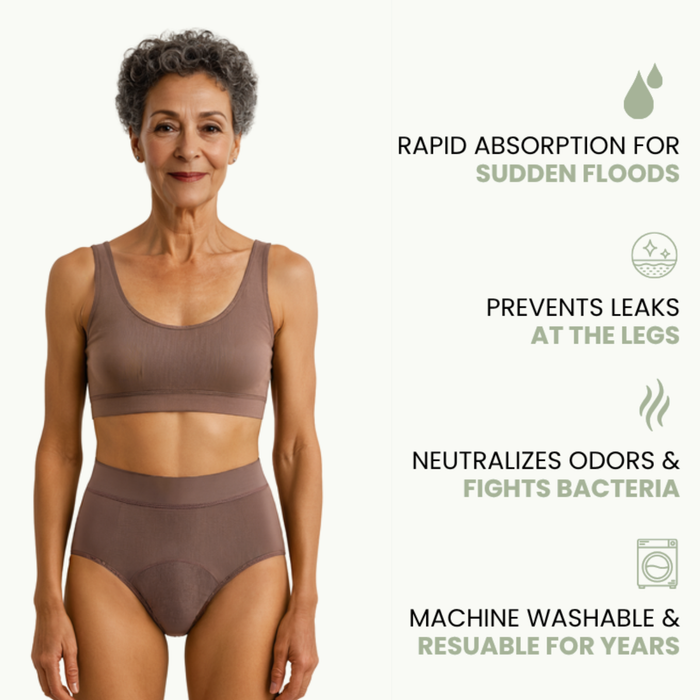
DryGuard Leakproof Underwear. Leak protection built into a soft cotton brief: a top layer pulls moisture away from your skin and the core holds up to 60 ml (about 2 oz). Sizes XS to 4XL, in black, beige, dark brown and light brown. Machine washable.
4.8 stars · 1,356 reviews on the DryGuard shop
$69 for 3 pairs (about $23 a pair) · free shipping · 6- and 9-pair packs also available
Over 50,000 women have chosen DryGuard.
This article is general information, not medical advice. If your leaks are new, getting worse, painful, or come with blood in your urine, please see a doctor.
More from the blog
Sources
- Nygaard I, et al. Prevalence of symptomatic pelvic floor disorders in US women. JAMA 2008 (NHANES 2005–2006)
- University of Michigan IHPI: Half of women over 50 experience incontinence, but most haven’t talked to a doctor (National Poll on Healthy Aging, with AARP)
- Randolph JF, et al. Change in FSH and estradiol across the menopausal transition (Study of Women’s Health Across the Nation). J Clin Endocrinol Metab 2011
- Stanford Medicine: Menopause – frequently asked questions (average age 51)
- US National Institute on Aging: What is menopause?
- MedlinePlus (US National Library of Medicine): Stress urinary incontinence
- The Link Between Menopause and Urinary Incontinence: A Systematic Review, Cureus 2024
- Mayo Clinic Q and A: Behavioral treatment can help control incontinence